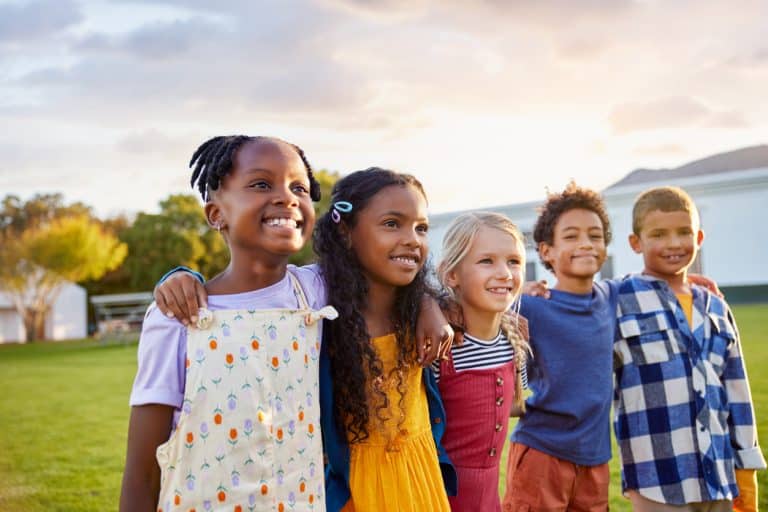


Thanks to global efforts to secure legal standards, children’s rights, protection, and wellbeing are now considered to be fundamental. However, children around the world still face many challenges. Nonetheless, professionals, parents, teachers, students and community leaders can support them in critical ways. Trained mental health professionals with psychology and social work backgrounds, in particular, can make a difference.
In this post, we’ll cover what World Children’s Day is, some of the challenges facing children and how psychology and social work interventions can help with child protection. We’ll also touch on how you can learn valuable supportive skills at SACAP Global.
What is World Children’s Day?
World Children’s Day is celebrated annually on the 20th of November. This date commemorates the UN General Assembly’s adoption of the Declaration of the Rights of the Child in 1959. World Children’s Day also celebrates the 1989 adoption of the Convention on the Rights of the Child by the UN General Assembly.
Therefore, the 20th of November marks the date on which the UN secured international recognition of children’s rights. After the 1924 Geneva Declaration laid the foundation for universal human rights, the above declaration and convention outline relevant standards for legal child protection. These standards aim to end cruelty and exploitation and advocate for access to adequate social, emotional and physical resources.
Therefore, although young people might not always have access to the same resources across different parts of the world, the UN has recognised their right to care and wellbeing as universal, regardless of their location or circumstances.
Children’s rights challenges we face today
Although the Declaration of the Rights of the Child and the Convention on the Rights of the Child were milestones in achieving a universal standard of care and wellbeing, many children still face numerous social and emotional challenges.
Some of these challenges include:
- Violence, neglect, and abuse
- Anxiety, stress, and mental health concerns
- Bullying and self-esteem issues
- Lack of safe learning and community environments
Global challenges
According to the most recent UNICEF State of the World’s Children report, these social and emotional challenges also happen in the context of greater issues. For example, in Africa, growing child populations face problems such as poverty and climate-associated risks.
Urbanisation is another challenge which calls for us to ensure that children have access to resources in expanding cities. Extreme climate events and the growing disparity between children who have access to technology and those who don’t are other factors that influence overall wellbeing worldwide.
On a global scale, bullying, and in particular, cyberbullying, can also affect mental health, as well as self-esteem, which can exacerbate mental health challenges such as childhood anxiety.
South African challenges
In South Africa, children and adolescents also face additional hardships, outlined in a 2024 UNICEF Situational Analysis. One of the key issues is multidimensional poverty, which affects 62% of children, predominantly in rural areas. Without access to basic amenities, children are vulnerable to all of the above socio-emotional problems, as well as other factors that may hamper childhood development.
Preventing violence against children is also critical, as up to 58% percent of children in South Africa face direct victimisation when it comes to sexual abuse. Some of this abuse can occur online, through baiting and manipulating children to share inappropriate sexual images and videos.
While the information and statistics shared above might paint a bleak picture, with insight into child psychology, mental health practitioners and social workers can provide much-needed child mental health support to help cope with myriad issues. Through interventions such as play therapy and other modalities, children can learn valuable coping skills and find safe spaces to express themselves.
The role of psychology and social work in child protection
Mental health practitioners with training in psychology and social work can play a vital role when it comes to supporting children in the following ways:
- Supporting mental health and resilience
- Creating safe school and home environments
- Advocacy and community development
Understanding child psychology, for example, can help to develop and implement appropriate measures and interventions, most notably when it comes to preventing violence against children.
Some of these preventative measures and interventions include the following:
- Early childhood development support
- Tools like play therapy, counselling, and trauma-informed care
- Building supportive networks for children and families
For example, early childhood development support initiatives can help support optimal social development. Interventions like play therapy, as mentioned above, can help identify emotional issues and provide children with relevant tools to cope in difficult circumstances.
Counselling and trauma-informed care are other vital support mechanisms which can help support children, especially in environments where children don’t have access to necessities. Sadly, the impact of a lack of social support is widespread, but we can mitigate it through appropriate interventions and through harnessing community involvement and support.
Take action this World Children’s Day
SACAP is committed to shaping change-makers who positively impact individuals, families, and communities. If you’re interested in learning more about children’s rights and looking to become part of the solution, take a look at our variety of short online courses and degree programmes.
Online short courses and workshops
SACAP Global offers various online courses and workshops, which can help you to empower yourself with the skillset to better support children today, including the following:
- Counselling Children & Youth
- Psychological Theories of Child & Adolescent Development
- Understanding Play Therapy
- Youth Mental Health First Aid
All of these courses can support mental health practitioners to provide more targeted support to those in need. Our Youth Mental Health First Aid course also highlights the importance of community and peer support, alongside proper mental health care.
Fully-accredited degree programmes
SACAP also offers fully accredited degree programmes that equip you with the skills to pursue a career in applied psychology or social work and development, empowering you to become a qualified mental health practitioner or social worker who can support both adults and children in coping with day-to-day challenges.
FAQ:
1. What is the purpose of World Children’s Day?
The purpose of World Children’s Day is to commemorate two essential milestones in securing children’s rights and to advocate for further protection of vulnerable children.
2. What are the most significant risks facing children today?
Children face numerous risks, including social problems such as multidimensional poverty, which impacts all areas of wellbeing. Mental health challenges, violence, abuse, bullying and lack of safety also affect children globally.
3. What is play therapy, and how does it help?
Play therapy is a modality that uses play to understand a child’s problems and help them learn valuable coping skills.
4. How can I get involved in supporting child protection and wellbeing?
By equipping yourself with mental health support skills and raising awareness, even the average person can help to support child protection and wellbeing.